
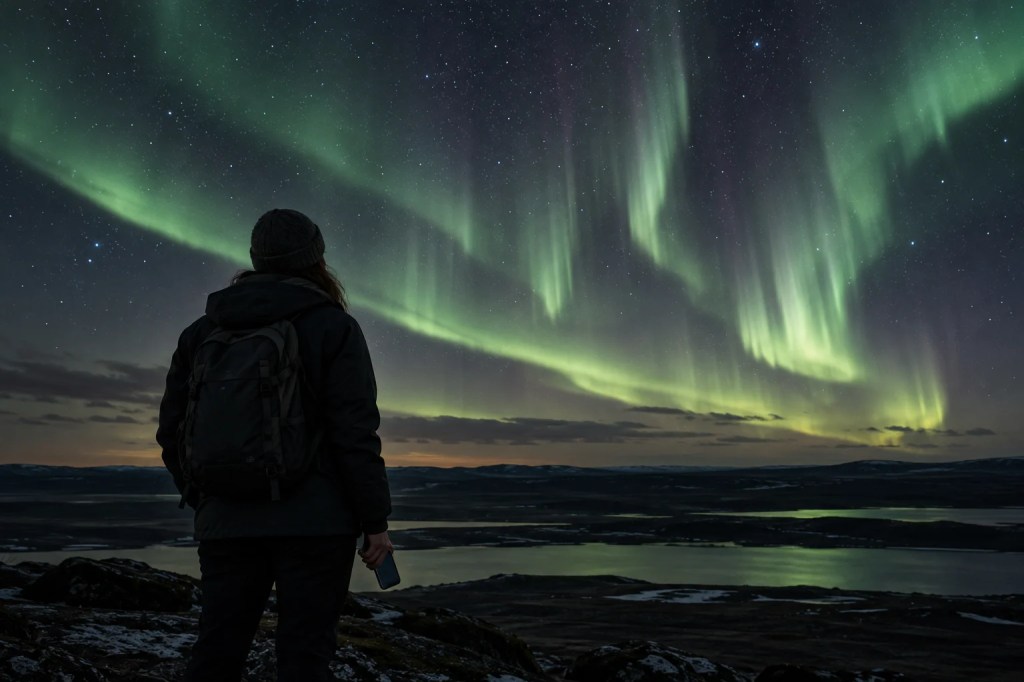
AI-generated illustrative aurora scene; not a forecast or a photograph of current visibility.
Science & Nature · By MundoGood · October 1, 2026
An aurora forecast tells you where and how strongly the lights may develop. It cannot promise a clear view from your backyard. To decide whether to head outside, combine the space-weather forecast with your location, local darkness and cloud conditions.
Start with NOAA’s aurora dashboard, then inspect the time attached to each product. This guide explains how to read those tools; it is not a prediction that northern lights will be visible tonight.
First, check what time the forecast covers
A screenshot shared earlier in the day may already be stale. Open the original product and check its timestamp, date and time zone before making plans. If it uses UTC, convert that time to your local time and pay attention to whether the date changes.
NOAA’s product called the 30 Minute Forecast actually describes a variable lead time of roughly 30 to 90 minutes, depending on the solar wind’s travel time from the observing spacecraft to Earth. It is a short-range tool, not an all-night guarantee.
NOAA also explains that when certain upstream measurements are unavailable, the model can use an alternative estimate without forecast lead time. That is another reason to read the product information rather than treating its name as a countdown.
Next, find your position relative to the auroral oval
The map shows a modeled region of auroral activity around the magnetic pole. Stronger colors describe greater predicted intensity, rather than the precise color you will photograph.
Being outside the brightest part of the oval does not automatically rule out a sighting. NOAA says a bright aurora can sometimes be seen from far away when conditions allow. Conversely, being beneath an active area does not remove the need for darkness and a clear sky.
Use the map to decide whether a viewing attempt is plausible, then check conditions at the actual place you can reach. Do not read the edge of a colored area as a precise fence dividing guaranteed sightings from impossible ones.
What the Kp number helps you understand
Kp is an index of planetary geomagnetic activity on a scale from 0 to 9. Higher activity generally allows the auroral oval to extend farther from the poles. It gives useful context, but the same number does not produce the same view from every location.
NOAA’s viewing guidance describes the relationship between Kp and viewing latitude as approximate. Someone close to the usual auroral zone may see a display at a relatively modest Kp, while someone much farther away may need stronger activity.
Avoid treating a single threshold from an app as a personal guarantee. Your latitude, the direction of the display and the local sky all matter.
Do the ordinary-weather checks too
Look at the local cloud forecast, visibility and any conditions that would make travel unsafe. Pick a permitted viewing location with a broad horizon and as little artificial light as practical. In the Northern Hemisphere, an unobstructed view north is often useful when the aurora is away from you toward the pole.
NOAA identifies the hours around local midnight as generally favorable, while stressing that activity varies. If your only safe opportunity is earlier, use the current forecast rather than assuming a display must wait for a particular clock time.
A short, nearby attempt may be a sensible choice when the forecast is uncertain. Plan a comfortable way to wait and a clear way home; do not make a long drive on the strength of an unlabeled social-media map.
Why photographs can look different from the sky
NASA’s guide to finding and photographing auroras explains the science and offers camera guidance. Cameras can reveal details that are difficult to notice at first glance, so a vivid photograph is not a reliable preview of what your eyes will see.
Take time to look away from bright screens. If you photograph the sky, steady the camera and use its low-light options. Treat any image as a record of that exposure, rather than proof that every nearby observer saw the same brightness.
A final check before leaving
Ask four questions: Is the forecast current? Is my location plausibly placed? Will it be dark and reasonably clear? Can I get to a suitable viewing spot safely? If one answer is missing, resolve that before treating a high activity number as a plan.
Google included the northern lights among the breakout themes in its 2024 Year in Search. That is historical evidence of public curiosity, not evidence of a current solar storm. For tonight’s conditions, return to the live forecast.
Editorial note: This AI-assisted article synthesizes the linked sources, checked October 1, 2026. It does not claim hands-on product testing.


Leave a comment