
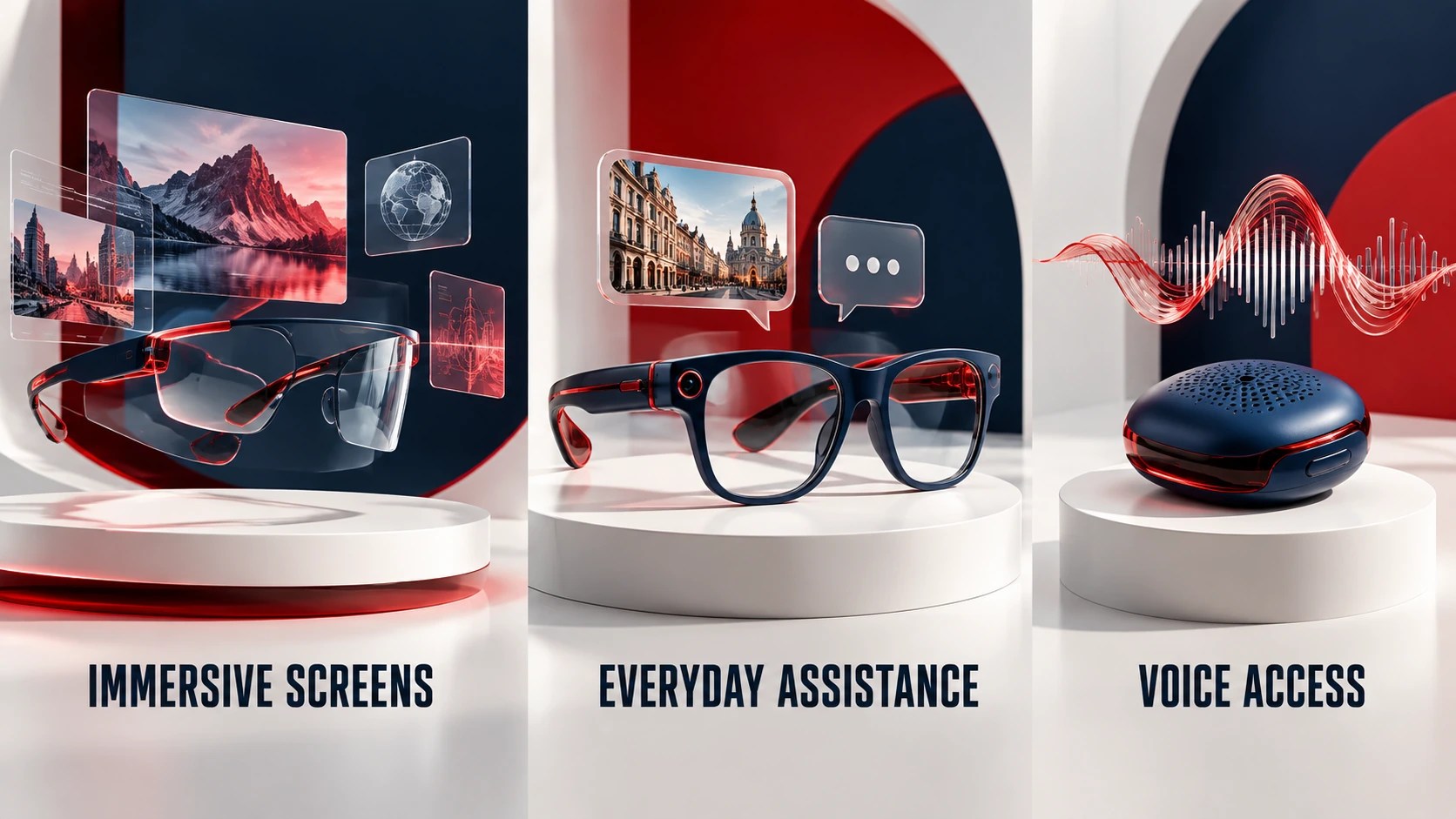
AI-generated conceptual illustration; not an exact product depiction or an app screenshot.
Meta’s glasses announcements span different jobs: immersive entertainment, everyday assistance, and hands-free audio. Here’s how to separate the products, understand their announced prices and release windows, and decide which category deserves your attention before spending money on the wrong device.
RESEARCH BRIEF · Last checked September 30, 2026 · 6 min read
The quick answer
Meta VR Glasses target immersive viewing and work. Meta’s AI glasses handle everyday assistance, with different capabilities across models. Muse Charm is a separate pocket-sized voice device. These are distinct categories, even though Meta discussed them together at Connect. Meta’s Connect roundup
The useful first question is simple: Do you want another screen, or fewer reasons to reach for your phone? That choice narrows the field faster than a list of processors, frame colors, or AI promises.
This is an announcement-based guide, not a hands-on review. Our recommendations below are reasoned use cases, not claims that we have tested comfort, sound, battery life, or software reliability.
In this guide
- The lineup at a glance
- What makes the VR Glasses different?
- What everyday AI glasses offer
- Where Muse and Muse Charm fit
- A practical decision guide
- The limitations worth checking
- Frequently asked questions
The lineup at a glance
Prices and dates below are Meta’s published US-dollar announcements, checked September 30. They are not live inventory checks or checkout totals.
| Product | Main job | Announced price and timing |
|---|---|---|
| Meta VR Glasses | Immersive screens | $1,299.99; spring 2027 [1] |
| Ray-Ban Meta Audio | Calls, music, voice AI | From $349; preorders announced September 23, shipping October 13 [2] |
| Ray-Ban Meta Gen 3 | Camera-equipped everyday AI glasses | From $449; available from September 23 [2] |
| Meta Ray-Ban Display | Everyday information on a display | US online ordering began September 23; price not stated in the cited update [3] |
| Muse Charm | Pocket voice access to Muse | Price and sale date not specified in the cited announcement [4] |
Sources: 1: VR Glasses launch announcement, 2: AI glasses launch announcement, 3: Display update, 4: Connect roundup.
What makes the VR Glasses different?
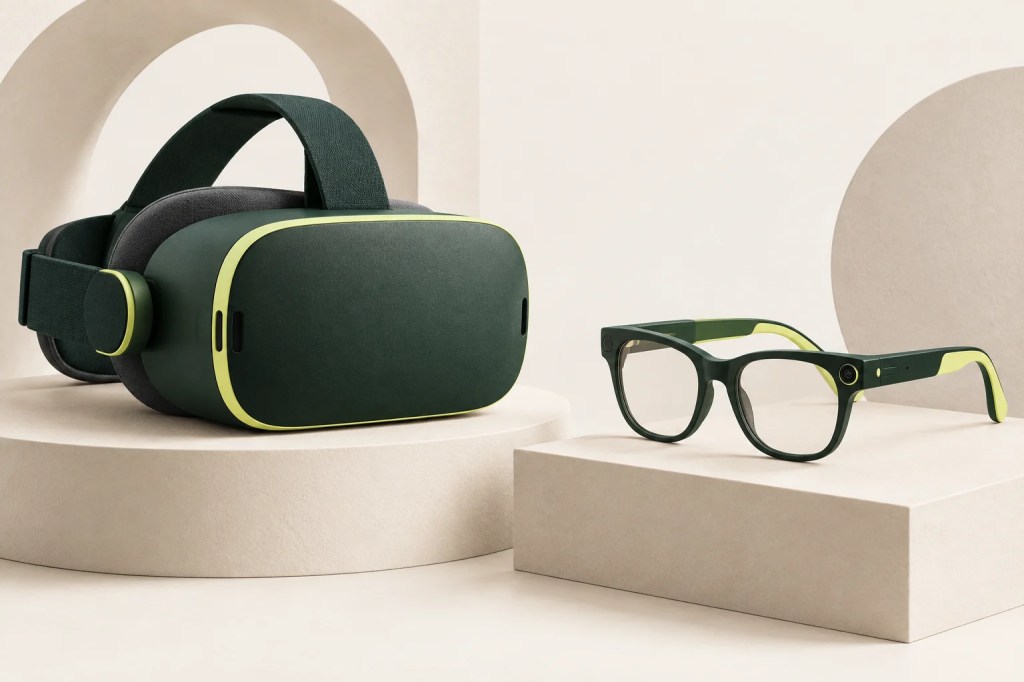
Meta describes a two-part system: approximately 100-gram glasses connected by an optical tether to a puck containing the computing hardware, battery, and storage. Announced features include micro-OLED displays, immersive media, multiple virtual work screens, and a flat-surface keyboard and touchpad. Meta claims up to three hours of continuous high-resolution media playback. VR Glasses announcement
That separation matters when evaluating portability. Ask where you would put the puck, how the cable would sit, and whether your usual seat or desk makes the setup convenient. A lower weight on your face is useful context; it is not proof that the whole arrangement will disappear into your day.
Our strongest hypothetical use case is a person who regularly wants a private viewing space while someone else uses the television. Before buying, that person should write down three specific things they would watch and verify access to each. A broad entertainment pitch is less valuable than knowing your actual evening routine will work.
What everyday AI glasses offer
Ray-Ban Meta Audio is pitched around listening, calls, and voice assistance. Gen 3 adds a 12-megapixel camera and 3K video recording; Meta also identifies a capture-indicator LED. The company rates Audio at up to 12 hours per charge and Gen 3 at up to nine hours. These are manufacturer figures, not our measurements. AI glasses announcement
Meta Ray-Ban Display is another branch of the lineup. Its September update describes visual navigation and calendar functions, while mirrored phone notifications are marked as forthcoming. Feature timing and regional restrictions vary. Display update
For a podcast listener, the first comparison should be against the listening setup they already own. For someone who wants spontaneous first-person photos, camera controls and recording etiquette deserve more attention. For someone who wants glanceable directions, test whether the information is easy to read and whether the relevant feature is available locally. These are different shopping checklists, not merely different budgets.
Where Muse and Muse Charm fit
Muse is the agent; Muse Charm is a device for talking with it. Meta said Muse would reach AI glasses in the coming months, while promising more information about Charm later this year. Do not read either statement as confirmation that the whole experience is available today. Connect roundup
The sensible Charm question is whether a dedicated voice device would solve a recurring annoyance. If you cannot name that annoyance yet, waiting costs little. A future product does not need a place in your purchasing plan merely because it shares an ecosystem with something you already want.
A practical decision guide
Start with the activity you would repeat three times a week.
- A private movie or focused desk session: Put VR Glasses on a watchlist. Seek a demo and independent evaluations before committing. Decide in advance what would make the experience better than your current screen.
- Podcasts and frequent calls: Compare Audio with your existing headphones. Prioritize fit, speech intelligibility, and whether you enjoy wearing glasses for that purpose.
- Quick photos without holding a phone: Investigate camera-equipped models. Think through when recording would feel welcome, when you would ask first, and how easily you can tell capture is active.
- Glanceable information: Investigate Display. Make a list of the exact notifications, navigation tasks, or calendar actions you expect, then confirm support individually.
- Mostly curiosity about the agent: Explore the software before buying another device. Judge whether it reliably helps with a task you already do.
The limitations worth checking
Confirmed announcements are not verified performance. Meta’s comfort language, battery ratings, and descriptions of immersive experiences come from the manufacturer. This article verifies what was announced; it does not independently establish those outcomes.
Before spending, check prescription compatibility, your phone and account requirements, local availability, app support, return terms, and any subscriptions needed for the activities you want. Do not assume one model’s capabilities apply to another simply because both use the Meta name.
Finally, treat a future feature as a bonus rather than the reason to buy. A useful test is: would you still want the product if that feature arrived later than expected?
Frequently asked questions
Can I buy Meta VR Glasses now?
Meta’s announcement schedules sales for spring 2027. It does not provide an exact day. VR Glasses announcement
Are VR Glasses a self-contained pair of spectacles?
No. The announced design uses a tethered puck. Include that second piece when considering where and how you would use them. VR Glasses announcement
Should I wait for Muse Charm before choosing glasses?
Only if dedicated voice access is your main interest. There is not enough published pricing or release information in the cited announcement to make a meaningful value comparison. Choose around a present need, then revisit Charm when its details become concrete. Connect roundup
Sources and methodology
This article synthesizes the linked official documentation and announcements, checked September 30, 2026. It is not a hands-on product test. Availability, features and published information may change.


Leave a comment