
English · By MundoGood · October 7, 2026
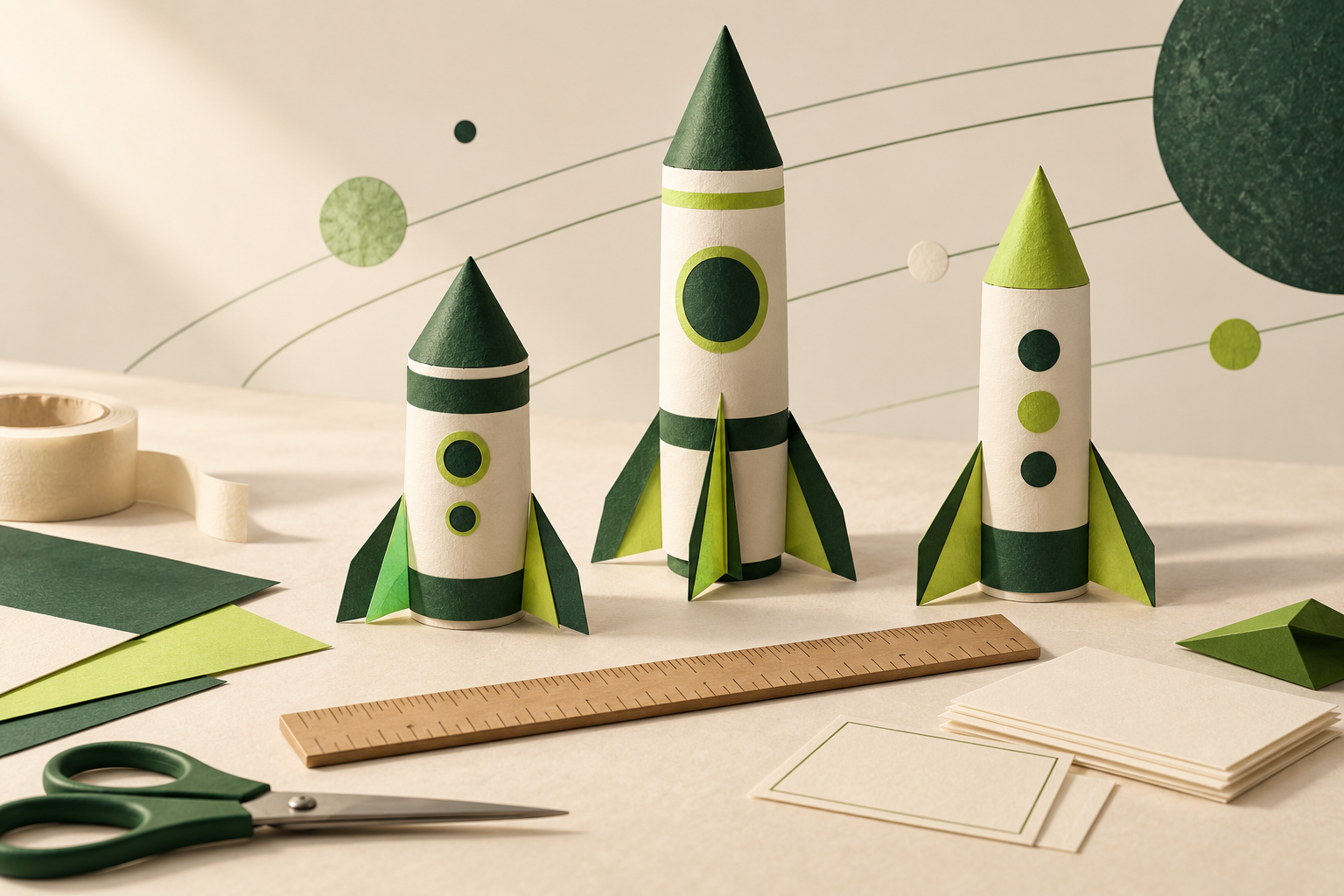
AI-generated conceptual illustration of paper-rocket activities; the pictured models are not construction instructions.
World Space Week 2026 runs from October 4 to 10 under the theme “Rocket Revolution.” The United Nations describes a focus on changing access to space, including commercial providers, reusable rockets and new participants. For a classroom, library or family, that creates a useful question: how do engineers improve a design when time, materials and performance all matter? United Nations: World Space Week.
There is still time to take part this week. Choose one activity with a clear learning goal, rather than trying to assemble a complete space curriculum before October 10. The plan below is an original suggested format, built around freely available NASA education resources.
Pick the outcome before the materials
For younger learners, a good outcome is explaining a prediction and describing what happened. For older learners, aim for a comparison supported by measurements. A group that leaves knowing why its second test was fairer than its first has achieved something useful, even if its paper rocket flew a shorter distance.
Three practical routes suit different settings:
- A short home session: make one paper rocket, predict its flight and measure the result.
- A classroom lesson: compare a baseline design with one controlled modification.
- A library or club meeting: combine the experiment with a discussion about the purpose of space missions.
NASA JPL’s Make a Straw Rocket provides the construction template and instructions. It lists grades 4–8 and a time requirement under 30 minutes; allow longer for setup, repeated tests and discussion.
A one-hour paper-rocket session
This is a suggested teaching schedule, not an official World Space Week program.
First 10 minutes: set the question. Ask whether changing one feature, such as fin size, changes flight distance. Gather paper, tape, scissors, a pencil, an individual straw for each launcher and a measuring tape. Mark a clear launch line and explain the safety rules before building.
Next 15 minutes: build the baseline. Follow the NASA template. Keep a sample unchanged so the class has something to compare against. Give participants different roles, including builder, recorder and observer, so blowing into a straw is not the only way to participate.
Next 15 minutes: test and record. Use the same launch point and a consistent method of measuring distance. Repeat each design several times. Write down every result, including a short flight or a sideways landing, instead of keeping only the longest attempt.
Next 10 minutes: change one feature. Modify the fins or rocket length, then repeat the same testing method. NASA’s teacher lesson emphasizes changing one variable at a time. Changing the fins, launch angle and rocket length together makes it difficult to identify what affected performance.
Final 10 minutes: explain the evidence. Compare the range of results. Did the modified design consistently improve, or did the best flights overlap? Ask what the group would hold steadier next time. Differences in blowing strength and angle are useful examples of experimental limitations.
Keep launches away from faces, people and fragile objects. Supervise scissors and use individual straws. This activity needs no fuel, flame or pressurized bottle. The paper model is launched by air from the straw; it does not reproduce a full rocket engine or orbital flight.
Connect the model to a bigger engineering problem
Once the group has measured a design change, introduce a mission constraint: what if the rocket must carry something? NASA’s Heavy Lifting activity uses balloon-powered vehicles guided along a line to explore payload. Use the official setup instructions and adult supervision, checking balloon allergies and keeping small parts away from young children.
A discussion-only alternative needs no extra equipment. Give teams a fictional mission and ask which requirement matters most: carrying more instruments, protecting a delicate payload or recovering hardware for reuse. Have them explain their choice. The aim is to practice trade-offs; a classroom flight-distance contest alone cannot tell us which real launch system is best.
Find an event that fits your group
The World Space Week Association provides a global event map and participation information. Treat a listing as a starting point and confirm details with the host before travelling or promising attendance.
Check the local date and time zone, age range, booking requirements, price, accessibility, supervision rules and weather contingency. For an online event, confirm whether it is live or recorded and whether captions are available. Avoid assuming that an event is free simply because it is part of the week.
Finish with one question each participant wants to investigate next. Save the designs and measurement sheets together. They make a useful starting point for a later engineering lesson, long after the observance ends.
Sources and review
Checked October 7, 2026. Sources: the United Nations and World Space Week Association for the observance; NASA JPL’s linked project and lesson pages for educational activities. The one-hour schedule, discussion prompts and event-checking checklist are MundoGood’s suggested adaptations. Local availability and host arrangements can change.
Editorial disclosure: AI assisted with research and writing. The linked sources were checked for this article.
Sources checked October 7, 2026. AI-assisted research and writing.