
English · By MundoGood · October 5, 2026
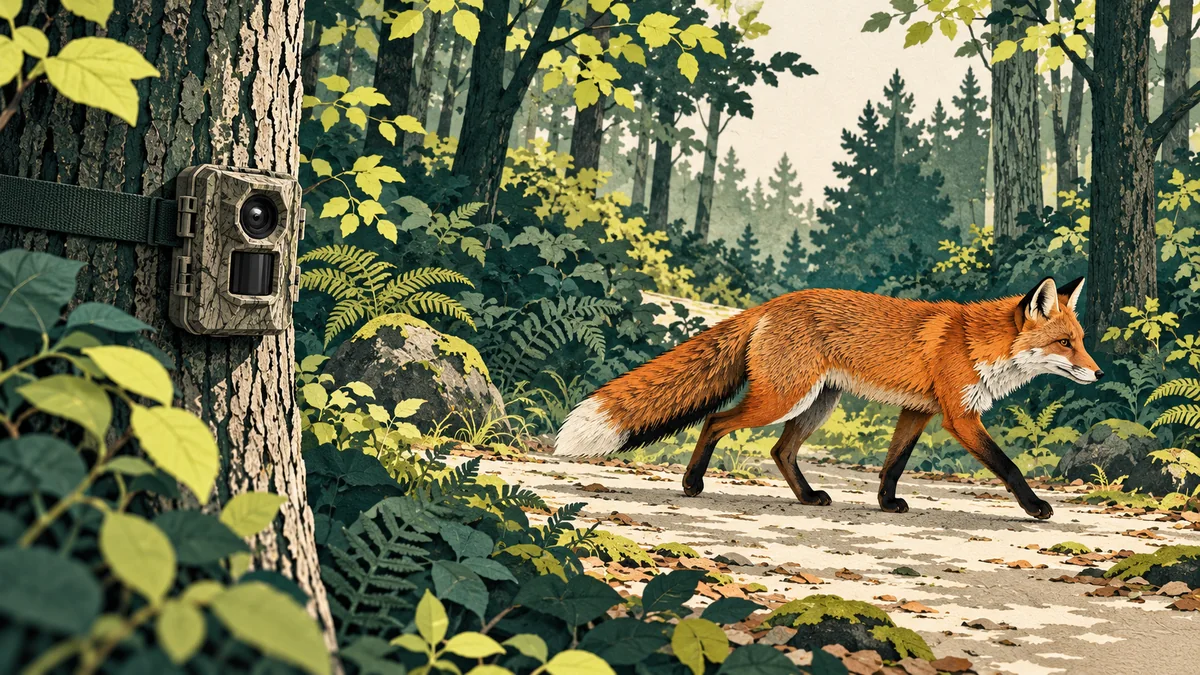
AI-generated conceptual illustration of a trail camera observing wildlife. It does not document a real animal sighting.
A camera trap can record an animal while nobody is standing nearby. A fox crossing a path at night becomes a dated observation that someone can review later. With a suitable study design, many such observations can help researchers investigate where animals occur, when they are active and how they use a landscape.
The camera is the visible part of the work. The less photogenic details, including placement, operating time and identification uncertainty, determine how much the pictures can tell us.
How the camera notices an animal
Many trail cameras combine a camera with a passive infrared trigger that responds to moving heat. An animal entering the sensor’s detection area can start a burst of photographs or a video. The National Park Service’s Kenai Fjords account describes using these devices to observe wildlife without keeping a person at the site.
That account also gives a concrete research example: cameras helped staff identify predators visiting monitored oystercatcher nests and record other events around the nests. This was a specific research project, not an invitation for visitors to install equipment beside nests themselves.
A photograph is a detection
A clear, correctly identified photograph supports the presence of an animal in the camera’s view at that time. It does not automatically reveal how many different individuals live in the wider area. One fox might return repeatedly; a second fox might use a route outside the frame.
A Smithsonian-led camera-grid study found substantial variation in detection and capture rates even among nearby cameras in a small forest plot. Animal movement and small differences around each station helped complicate interpretation. Researchers therefore need appropriate sampling and analysis before turning photographs into broader population claims.
For a home project, a defensible first question is simply: which animals did this camera record here during this period? Keep the answer at that scale unless you have the design and expertise to support more.
Keep operating time beside the sightings
A week with no wildlife photographs has several possible explanations. Animals may not have passed within range, the camera may have missed them, or the equipment may not have been working. A blank result should be recorded with its context.
Wildlife Insights defines a deployment as a camera operating at a location during a particular period. Its records include start and end dates and a quiet-period setting, the interval when a camera waits before triggering again. These details help make observations interpretable.
Keep a simple log with the station identifier, dates, settings, battery or card changes, and known interruptions. Separate confirmed operating time from periods when functionality is uncertain. If two cameras produce different numbers of photographs, first ask whether they were actually collecting comparable records.
Set up around a question
The WildCAM setup guide emphasizes matching the setup to the research objective. For a modest observation project:
- Choose the target area and write down why you selected it.
- Mount the camera securely, with height and angle appropriate to the animals and terrain.
- Keep the sensor and lens unobstructed without unnecessarily altering vegetation.
- Check the clock, battery supply, memory card and recording settings.
- Perform the manufacturer’s walk test and inspect a test photograph before leaving.
Avoid adopting one universal mounting height or interval from a video. A setting suitable for a large mammal can miss smaller animals. For general wildlife observation, leave out bait and scent lures: they change detection patterns, and WildCAM warns that bait near urban areas can increase human-wildlife conflict. Check the site’s rules before deploying anything.
Protect wildlife and people’s privacy
Get the landowner or land manager’s permission and follow the project’s protocol. The Smithsonian eMammal FAQ advises low-human-traffic locations away from roads and explains that public-land projects may require permits or specific approval.
Before sharing photographs, review whether they reveal people, private spaces or sensitive wildlife locations. eMammal withholds precise endangered-species locations from public release and describes protective handling of photographs containing people. For your own project, a cautious approach is to avoid publishing identifiable people or precise locations that could expose vulnerable animals.
If you come across someone else’s research camera, leave it and the surrounding habitat undisturbed. The purpose of the equipment may not be obvious from the path.
Make the records useful
Keep the original files and review sequences, rather than counting every frame as a new animal. When identification is uncertain, retain that uncertainty instead of choosing the most exciting species. Wildlife Insights distinguishes individual images from sequences, where several photographs can show the same animals. Follow your project’s event definition and keep uncertain identifications flagged for review.
A useful final note might say: “Fox recorded on three evenings; camera operating dates and settings logged; individual identity unknown.” That modest statement is more informative than a population claim built from a handful of appealing pictures.
Sources checked October 5, 2026. This article was researched and drafted with AI assistance. The accompanying image is an AI-generated conceptual illustration and does not document an actual wildlife sighting.