
English · By MundoGood · October 2, 2026
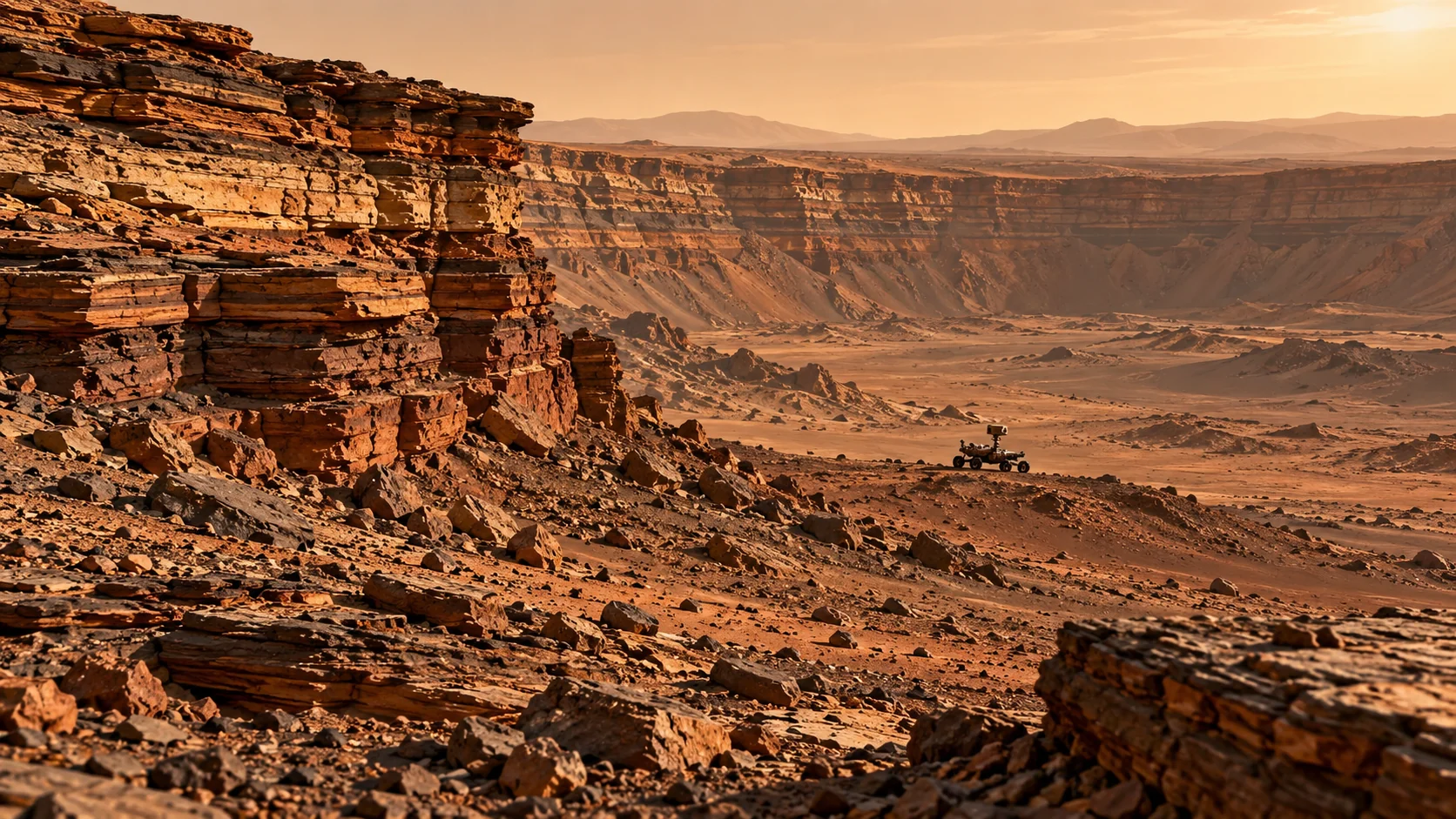
AI-generated conceptual illustration of Martian geology; not a mission photograph or reconstruction of a specific site.
Perseverance’s latest water story is about changes recorded in rock. In a September 21, 2026 announcement, NASA described evidence that rocks in Jezero Crater’s Margin Unit interacted with water on at least three separate occasions. The findings complicate the picture of a place once interpreted mainly as an ancient lakeshore. They do not establish that Mars hosted life. NASA’s announcement.
The reader’s most useful question is: what was observed, and what history does it support? Keeping those two steps separate makes the discovery more interesting and avoids turning evidence for water into an unsupported claim about organisms.
The surprise was the kind of rock
The Margin Unit lies along the inner edge of Jezero’s rim. Orbital observations had detected carbonates, which made a lake-related explanation attractive. Close-up investigation instead found an igneous starting material: rock formed from molten material, later changed by water. NASA reports that coarse olivine crystals at higher elevations indicate slow cooling underground. The Margin Unit findings.
Two questions therefore have different answers. “How did this rock first form?” concerns its origin. “What happened to it later?” concerns its subsequent history. A rock can begin in a magma body and still preserve valuable evidence of later water.
That distinction prevents a common misunderstanding: discovering igneous rock in a former lake setting does not, by itself, mean the lake never existed.
Three episodes, with different clues
Purdue University, whose Candice Bedford led the study, describes a sequence reconstructed from textures and mineral chemistry:
- Groundwater alteration: carbonate-rich ridges cross the bedrock, indicating mineral deposition along fractures
- Further water-rock interaction: silica and changes to earlier carbonates point to another episode, potentially involving the ancient lake or a changed groundwater system
- Later warmer fluids: a vein containing fluorite and calcium sulfate supports a subsequent hydrothermal event
The university emphasizes that the combination records a changing water history. The lake-related part of the interpretation remains qualified; it should not become a claim that researchers watched three distinct lakes form. Purdue’s explanation of the study.
An everyday analogy helps with the reasoning, though it is not a substitute for the measurements: a wall can reveal an original material, a crack repaired later, and a newer stain crossing the repair. Those features can indicate an order of events without giving you a calendar date for each one.
NASA makes a similar limit explicit for the Mars result: the team can establish the sequence of the interactions, but not their ages. What the result can and cannot date.
How a rover reads a rock without bringing it home
SuperCam combines imaging, a laser and spectrometers to investigate chemistry and minerals. Its job is to connect what the team sees with information about the material itself. A spectrometer separates light into a spectrum that scientists can use to investigate composition. NASA’s SuperCam instrument description.
For a reader, this is why a colorful rock photograph is only one part of the evidence. Visual texture, the position of a feature and chemical measurements answer different questions. The important result is their agreement in a geological explanation, rather than whether a shape happens to resemble something familiar on Earth.
This article summarizes NASA and the research team’s institutional explanations. It does not independently reanalyze the instrument data.
What about the ancient lake and delta?
Other Jezero observations address sedimentary environments directly. NASA’s mission summary describes lake-related sediments at Wildcat Ridge, a delta formed by sediment entering the lake, and evidence of later energetic flooding that transported large boulders. Those findings concern different materials and parts of the crater’s history. Perseverance science highlights.
The useful synthesis is that Jezero contains several kinds of geological records. Lake sediments and altered igneous rocks are complementary evidence. Asking which particular rock unit a headline describes is more productive than treating every discovery as a replacement for all previous findings.
Water, habitability and life are separate claims
Evidence that water altered a rock supports a reconstruction of its environment. Assessing habitability asks whether conditions could have supported life. Establishing that life actually existed is a further question requiring convincing evidence of a biological origin.
NASA describes some Jezero sedimentary environments as habitable for ancient microbes and valuable for preserving possible traces. It also frames detailed study of collected samples on Earth as a potential future step, not an analysis already completed. The mission’s sample and habitability context.
Use this three-question check on the next Mars headline:
- What did the instrument measure or image?
- What geological explanation do researchers infer, and where do they express uncertainty?
- Does the evidence concern water, potentially suitable conditions, or an actual biological signature?
The Jezero result is meaningful without a life-discovery claim. It shows how a rover can replace a simple interpretation with a more detailed account of the environments that once existed on Mars.
Sources and editorial note
MundoGood uses AI assistance to research and draft its guides. This article synthesizes the linked primary sources; it is not a hands-on test or an endorsement by the organizations mentioned.